107. My Untold Journey Through Trials with Pursuit of Gold Host Laura Wilkinson
In this special episode, listeners are invited to explore Laura's journey to Olympic triumph, shaped by resilience and determination. Approaching the 24th anniversary of a pivotal moment in her life, personal audio clips, as shared here today, recount significant moments along her journey that profoundly impacted her path. Laura’s tale of being a young diver filled with Olympic dreams and facing momentous decisions at times of relative uncertainty inspires many of the episode's themes such as overcoming adversity, embracing gratitude, and finding strength in challenges.
Using this momentous event as a springboard, the episode delves into resilience amidst adversity, from life-altering decisions to recovering from injuries. Through this intimate account, listeners gain insights into how resilience shapes Laura's responses to life's trials, and how gratitude emerges as transformative amidst setbacks, shifting her focus towards opportunities and fostering a positive mindset. As you will hear, community support proves vital in overcoming obstacles, brilliantly highlighting the importance of unity, and each setback becomes a chance for growth, paving the way towards Olympic success. As the world looks ahead to the upcoming Paris Olympics, Laura’s very personal reflection here today offers timely, hard-earned lessons and insights from her own stellar career that will prove invaluable to all those engaged in their own Pursuit of Gold.
Episode Highlights:
Facing career-altering decisions and overcoming devastating injuries
Embracing gratitude amid setbacks
Transforming obstacles into opportunities, fostering resilience, and maintaining a positive mindset
The pivotal role of coaches, teammates, and loved ones
How each setback serves as a chance for growth and self-discovery
Persevering through setbacks and challenges
Reflecting on past challenges
The anticipation building for the forthcoming Olympics in Paris
Conquering uncertainty and fully committing to Olympic dreams
How moments of reflection and gratitude provide solace and fortify determination in the face of adversity
Quotes:
"Every cloud really does have a silver lining. If you open your eyes, you'll find it."
"Recognize that although you may not be happy with the competition, there is more to life than that competition."
"Sometimes we will win that amazing gold medal and sometimes we'll miss it. But amazing things still happen because I didn't give up."
"Every obstacle that we face, there is an opportunity inside of it, but we have to be willing to find it."
"Find things to be grateful for. In the middle of the tough, in the middle of the painful, in the middle of the hard, there is something to be thankful for. Fill your mind with that and focus on those things."
Links:
Laura’s Social Media:
96. How to Create a Thriving Team Culture with Coach J.P. Nerbun
Laura’s very special guest this week is J.P. Nerbun, founder and co-host of the highly acclaimed sports leadership podcast, Coaching Culture. With an accomplished career as a professional basketball coach spanning over a decade, J.P. Nerbun has become a world-renowned leadership coach, sports consultant, and visionary founder of TOC, a leading global sports-consulting and coaching business.Throughout his career, he and his team have provided personalized coaching and practical resources to hundreds of leaders across various industries, including sports, education, medicine, and business. He is also the acclaimed author of Calling Up: Discovering Your Journey to Transformational Leadership and The Culture System: A Proven Process for Creating an Extraordinary Team Culture. J.P.’s ‘The Culture System Online Training Platform’ launched earlier this year.
Drawing from his unique perspective as a former athlete, J.P. provides actionable guidance tailored for coaches, athletes, and parents alike seeking to elevate their leadership and culture-building skills. He goes on to share his personal journey and rich leadership experience, and offers insights into effective coaching practices, parental involvement, strategies for handling challenging situations, and the keys to achieving success. Together with Laura, J.P. also delves into the critical role of team culture, crafting coaching philosophies, nurturing relationships in youth sports, and addressing abuse in sports with a positive approach. Brimming with a wealth of wisdom on fostering exceptional team cultures and honing leadership abilities in the sports world, the insights discussed by J.P. and Laura here today will undoubtedly ignite your passion to create positive and impactful experiences in the realm of sports and beyond.
Episode Highlights:
Team culture's crucial role
Crafting coaching philosophy
Building relationships in youth sports
J.P.'s transformative journey and experience in culture and leadership
Addressing abuse in sports and coaching with a positive impact
Effective coaching and parental involvement
Handling challenging situations
Keys to success
Quotes:
"If someone is tearing you down as a human being, they criticize your play, that's one thing. But especially to be critical of you as a human being constantly, that you feel less, you feel like you're not worthy... just walk away."]
"I wish I could go back so much and just tell that younger self to, hey, just tell him to stop. Just tell him, this doesn't work for me."
"I'm passionate, so I can be really high, and I can be really low. That used to be my excuse.”
"We want to create an environment that's intrinsically motivated for athletes, where they just want to show up and work hard and have a good attitude because that's who they want to be."
"My job as your coach is not to make you an Olympic gold medalist. My job is to create an atmosphere and an environment where you can become the very best that you can be."
"Your philosophy is like the outline; you allow the players to come in and color it in."
"Share it as an observation, not as a judgment. Be curious, not judgmental."
"The best way to invite change in others is to first change yourself."
"A great leader creates a future that wasn't possible without them."
Links:
Laura’s Social Media:
Connect with J.P.:
78. Faithful, available and teachable with Harlem Globetrotter Melvin Adams
Prepare yourself to step into a world of inspiration and resilience in this captivating episode of the Pursuit of Gold as Laura welcomes former professional basketball player, esteemed member of the Harlem Globetrotters, and true force of determination and triumph, Melvin Adams to the podcast. You are about to be treated to a heroic tale that defies the odds, as Melvin's journey unfolds from a humble upbringing in poverty to the heights of athletic achievement. Today, he and Laura delve into the details of that journey and uncover themes of conquering adversity, unearthing purpose beyond the realm of sports, and igniting a beacon of hope to illuminate the lives of others.
You will undoubtedly be captivated as Melvin shares his extraordinary narrative of rejecting limitations as, against the backdrop of discouraging whispers doubting his potential due to his height, Melvin chose to defy the odds and carve his own path to success. Rising as a two-time NCAA All American Basketball player, he surpassed others’ expectations and emerged as a prominent figure in the basketball world. Yet, his journey did not end there. Melvin discovered an unwavering passion for public speaking, harnessing his experiences to inspire and empower the younger generation. Join Laura and Melvin here today as they explore resilience, purpose, leadership, and the transformative power of sports, inspiring us all to reach our full potential and make a lasting impact on the world around us.
Episode Highlights:
Melvin's challenging upbringing and his use of basketball as an escape
The power of resilience, determination, and overcoming obstacles in Melvin's journey.
Melvin's transition to public speaking
His inspiring message of hope
Discovering identity and purpose beyond sports
Lessons learned about leadership and teamwork
Mentoring and passing the torch
Leading by example, finding personal identity, building relationships, and motivating others
Quotes:
"It does not matter where you start, but how you finish."
"Being a leader is not just being the best athlete. It's about character and setting an example."
"Basketball is just what you do, it's not who you are. And I think for so many athletes, we get caught up in our identity or our value even lies in the results at the end."
"You can speak to people till you're blue in the face, but when they see what you do, that speaks so much louder."
"If you have a gift and you're being pushed up, use your gift to bring other people up and make the world a better place."
"If you say you're going to commit to something, commit to it with your heart, your soul, your body, and your mind."
"The Globetrotters taught me that there was more to the game than just winning and losing."
"Don't just think it's going to be forever a winter blizzard. Even in your winter, you can make snowmen."
"It's not your circumstance, it's what you do with that and how you approach it and your attitude toward it."
Links:
Laura’s Social Media:
Connect with Melvin:
73. Falling Forward with Olympic Medalist Jonathan Horton
From wild child to Olympic medalist, Jonathan Horton is the kind of athlete who truly inspires, his determination and grit winning him silver and bronze Olympic medals. Jonathan begins the episode by discussing his experience as a hyperactive kid, including the time he climbed a twenty-five-foot support beam in the middle of Target! He then talks about how watching the ’96 Olympics women’s gymnastics team provided a moment of intense motivation that would help him become a pro gymnast. He also discusses the importance of finding your passion and not giving up, including taking new opportunities and embracing challenges.
Next, Jonathan chats about his time in college and how it helped him evolve from a self-centered athlete to a team member who supported and fought for his teammates. He then talks in detail about his Olympic experiences, from the doubts about the 2008 men’s team, to bonding through anxiety on the eve of team finals, to winning bronze against the odds. Plus, he shares how going for broke against his coach’s advice led him to a silver medal. Jonathan then discusses the injuries that led to the end of his gymnastics career and his one regret from that time before closing the episode with his experiences on Ninja Warrior and how he became a two-time author.
Episode Highlights:
From hyperactive kid to motivated machine
Finding your passion and taking on challenges
Learning to be a team member
Jonathan’s experiences at the Olympics
Competing on Ninja Warrior
Quotes:
“That was inspirational for me and millions, if not billions of people, to see those gold medals go over those women’s necks and watch the American flag go up in the air and listen to the national anthem. And I just remember thinking, ‘That’s it, that’s why I’m doing gymnastics, that’s what I want to do one day.”
“I think that you owe it to yourself to not quit on looking for that thing that fires you up and clicks in your brain and etches itself into your soul.”
“I was such an individual, selfish, self-centered athlete that only wanted to win win win for myself. And then, I got to college, and I quickly learned what it meant to have teammates that were all chasing after the same thing. And my first year of college was a steep learning curve where I had to toss all of my own, not all of my own self desires to the side, but really learn how to compete for the guys standing next to me.”
“We suddenly just became a brotherhood. We were more than just an Olympic team. We were a family of guys that were like, ‘Hey, screw it. I know that no one believes that we can win a medal. We barely believe that we can win a medal because we’re all panicking right now. But let’s just go out there. And we always said, grip it and rip it, just grab the equipment and just go.”
“My goal was always to be like Laura Wilkinson and win gold. I wanted that gold medal. And that’s what kept driving me. I never got to really call myself an Olympic champion. But I also tell people, I didn’t lose gold. I won silver, I won bronze, I didn’t lose anything.”
Links:
5 Ways to Stay Focused in a Competition
5 Smart Strategies to Confidence
Laura’s Social Media:
Jonathan’s Links:
Falling Forward: How An Ordinary Kid Failed His Way to His Olympic Dream on Amazon
If I Had Known: Life Lessons From An Olympic Pro Athlete on Amazon
65. Getting Uncomfortable with Navy Seal John Doolittle
Today, Laura welcomes John Doolittle, a retired Navy SEAL Captain and currently a certified KAATSU Master Specialist who serves as the Chief Revenue Officer of KAATSU Global. Laura and John open the conversation by talking about John’s swimming background and introduction to the Air Force Academy. Supported by his trusted mentor Mike, John decided to join the BUD/S training and become a Navy SEAL. Although the training was one of the most challenging and hardest periods of his life, it served as a great introduction to Navy life.
From becoming a team player to developing mental toughness, John says this program taught him some of the most valuable lessons in life. He dives deep into the power of trust and how it can be applied in sports, too, not just in the military. He goes on to explain the importance of adopting the ‘never quit’ mindset, highlighting its very powerful and contagious nature. Laura and John also address mental health in sports and the military, pointing out the importance of having strong team support and adequate resources. Finally, John shares an inspiring story about his solo swim across the English Channel to raise money for the Navy SEAL Foundation. He offers an inspiring conclusion to this extraordinary episode by stressing that you can accomplish anything in life if you do it for a reason greater than yourself.
Episode Highlights:
John’s swimming background and introduction to the Air Force Academy
Going from the Air Force Academy to the Navy
The challenging journey of getting into the BUD/S class
The three phases of BUD/S training
Mental toughness vs. physical toughness
Learning to be a team player
Adopt a ‘never give up’ mentality
The importance of trust in teamwork and relationships
The power of little things
Protecting the homeland after 9/11
Pushing yourself without hitting the breaking point
John’s solo swim across the English Channel to raise money for the Navy SEAL Foundation
Quotes:
“One of my biggest takeaways from my time in the teams was about relationships based on trust. And you know why - that starts with our parents, but it also starts with mentors.”
“Everyone fails physically pretty quick. That first night, you go to failure on just about everything you do. But the mental piece is so important. And you learn very quickly, that when you thought your body was done, you actually do have more to give.”
“You quickly learn at BUD/S training that if you're trying to do something as an individual, you will fail. There are very few things, even this swimming in BUD/S, you can't do it by yourself. Everybody has a swim buddy. And if the two of you fail, don't make the time, you both failed the swim.”
“Part of the goal with that type of training is to identify those that when they get really uncomfortable, when they get really tired, they end up making decisions that maybe are not the best. And whether or not somebody is going to quit, you want to identify that pretty early on.”
“'Never quit mindset' is very, very powerful and contagious to others on the team.”
“When you're doing something really hard in life, try and find a way to do it for something that's bigger than yourself, it's bigger than you, to do it for a reason greater than yourself and you can do damn near anything.”
Pursuit of Gold Podcast is brought to you by Kaatsu Global
Links:
Laura’s Social Media:
Connect with John:
54. Always be Ready to Pivot with Olympic Silver Medalist Lauren Gibbs
With the Winter Olympic Games upon us, it's perfectly fitting to bring Lauren Gibbs back on the show. If you haven't already heard Lauren's incredible journey from the corporate world to the Olympic podium in just three years while in her 30s, all you need to do is go back to Episode 6 - 'You're Never Too Old To Dream Big with Olympic Medalist' - and listen to her hilarious and wild journey into the world of bobsled. Throughout her career, she has made eight national teams, competed in 44 World Cups, and has won 17 World Cup medals, two World Championship medals, one of which was gold in 2020, and an Olympic medal in 2018. Today, Lauren provides an update on her incredible story.
She picks up the story at the point where the pandemic began to derail training and sponsorships, and goes on to describe the mindset shift she went through and the value of always being ready to pivot. As always, Lauren is open, candid, and vulnerable, as she discusses not being chosen for the Olympic team a second time, the struggle of keeping a certain weight to compete, and how she became friends with her competitors. She also offers some great advice about learning how to tell your story to attract sponsors and supporters, and about different apps to help athletes on various stages of their journey. Lauren finishes up by giving us a rundown of athletes to keep an eye out for at the Winter Games, and an update on what she is up to these days, especially her work with Heroic. A remarkable woman with an equally remarkable story to share, Lauren Gibbs demonstrates once again here today that she is a talented, resilient, and inspiring individual from whom we can all learn so very much about both sport and life in general.
Episode Highlights:
Lauren Gibb's astonishing career from age 30
How she was affected by the pandemic
Lauren's work with Kara Winger on Parity
How she pivoted and supported herself with COVID and the Tokyo games being postponed
Lauren's physical, emotional, and mental state
Her advice and insight for aspiring athletes
The value of sharing your story in your athletic career
Her transformation from high school and college to now
The difference between quitting and knowing when it's time to move on
The uniqueness of bobsled and how Lauren navigated its complexity
The adrenaline letdown after success
Lauren's friendship and connection with Kaillie Humphries and Elana Meyers Taylor
The competitive dynamics among women in the same team in sports
The challenges women face in sports, particularly Olympics
Insights on the upcoming Winter Sports and exciting newcomers
Update on what Lauren is currently doing
Details about Heroic and her work there
Quotes:
"It's been tough to see people struggle. I've been very fortunate, but I enjoy life with other people. And so, to see people around you and people you don't know struggling is always hard. My heart goes out to anybody that's been adversely affected by the pandemic. That's a lot of people."
"Then, when the pandemic hit, everything went away. And it was a quick lesson to me on how quickly life can change and how you have to prepare for a pivot. So you always have to be ready for a pivot."
"Olympics was never my end goal when I started bobsled, which I think sounds probably crazy to most people."
"You have to figure out what your story is because everybody has a story that people can learn and grow from."
"People just want to know about real people. They want to know about your struggles, successes, and the weird things you do in your sport that people would never think of. So share as much as yourself as feels comfortable, but also remember, once you share it, you can't take it back. So really show up as yourself."
"Don't try and be this person you think everybody wants to see or hear from because no matter who you are, there's enough people in this world that your story will click with - the people that it needs to click with."
"As someone who's on the other side, I can't wait to help athletes that need help in their journey because people help me. So I think just realize that more people out there want to help you than you think. So you’ve got to share your story and figure out what you're all about."
"I was one of those people who were fairly good at a lot of things. And so, when things got difficult, I would just quit. And I've realized that quitting feels worse than failing. And I was always more afraid of failure than I was excited for success, that I would quit before I got there. I've learned that that's more dissatisfying because you don't really learn anything from just quitting."
"That conversation with my dad was such a gift. He wasn't telling me that the Olympics weren't worth my time or worthless. Basically, he was telling me that the Olympics don't define Lauren Gibbs. And it can be so easy for an athlete to feel defined by their successes or losses in a sport. That's unhealthy. That's not good. You should do it because you love it. "
"You are not your sport; your sport is something that you do."
"If you're depending on this result to change how you feel about life or yourself, whether you get the result or not, it's not going to do it."
"That's how you become a leader at anything. You have a goal in mind, and you work towards that daily. It really focuses on the small wins and the daily activity and then having this great support system."
Show Links
Life at 10 Meters: Lessons from an Olympic Champion
5 Smart Strategies to Confidence
Laura's Social Media:
Lauren's Social Media:
43. How wisdom and experience are earned with professional cyclist Brad White
Professional cyclist, Brad White, joins Laura on the podcast this week. While working as a teacher, Brad discovered professional cycling somewhat later than most, but enjoyed great success in a very short amount of time. Eventually leaving teaching behind, he went on to compete internationally full time, and, upon retirement from the sport, has found a way to continue to make his passion his livelihood. Filled with wisdom and experience both within the sport and beyond, Brad has much to share with listeners today.
He starts off by recounting his rather unique beginnings in his sport, his transition to becoming a professional rider, and the type of cycling in which he competed. Brad goes on to share details regarding the team aspect of the sport, his preparation for races, the importance of patience in sports, and some of his most memorable moments. His training focus, special awards, definition of success, and transition out of professional cycling are also explored. Brad finishes up with a description of the work he does these days which keeps him connected to the world of cycling. As Laura notes, Brad’s wisdom and experience is ‘hard earned’, and today he demonstrates once again that so much of what is learned through sport is remarkably valuable in so many aspects of life in general.
Episode Highlights:
· How Brad found cycling
· His transition to becoming a professional
· Tours and road racing
· Team selection, training, and roles
· Preparing for races physically and mentally
· Developing patience
· Brad’s most memorable moments
· Where his nickname came from
· Brad’s training program focus
· Some of his special awards
· His definitions of success when he was racing and now
· Brad’s transition out of professional cycling
· Moms in Tow
· Velo Kids
· Velo City Cycles
Quotes:
“The next thing I knew…I was not teaching anymore, I was racing.”
“It's really important that you know your role, you can execute your job, but also that you show up ready.”
“The preparation for each course is going to be different, but kind of the same, and then you're just going to react differently.”
“The overall time is what matters to some riders, but then, to other riders, winning a stage is a big deal.”
“If I need to suffer this that little bit longer, you know, they may give up.”
“I think one of the biggest motivators for me was just not wanting to let down my team, my fans.”
“Patience is a huge part of, I think, all sports.”
“We were just riding so well together all the time, having fun on and off the bike.”
“I think there's definitely something about, even with a training plan, listening to your body and being able to react to what your body is dealing with, and get the most out of your training.”
“Kind of racing stupid made me stronger, made me a little smarter later, but it also got my name out there a little bit.”
“Being able to achieve what you set out to achieve that day is a success.”
“I think the biggest thing for people transitioning out of sports is you don’t need to find the thing right away.”
“The bike has done so much for me within my career but also, you know, mentally, physically, spiritually, it's connected me with people…and it's amazing what I've seen it do for people.”
“With COVID, bikes have been a big hit.”
“The programs we have are to give back to our community and to create experiences for people to use the products that we’re selling them.”
“You can make your sport very much a part of your life and still have that love for it and just bring it out in different ways.”
Links:
5 Smart Strategies to Confidence
Laura’s Social Media:
Connect with Brad:
38. Paralyzed to Powerful with Rugby Player Robert Paylor
Laura has been looking forward to today’s interview for a while, and the reason will become very clear, very quickly. On May 6, 2017, Robert Paylor was playing for the number one college rugby team in the country as they competed in the National Championship, a dream come true for any young athlete. Mere moments into that game, Robert broke his neck and was subsequently told that he would never walk or move his hands again. His life was changed forever in that instant, but if you think that’s where Robert’s story ends, you couldn’t be more wrong. That fateful day not only impacted his physical life, but his mindset, his faith, and his outlook on life, and he shares the whole story with us all today.
He begins by describing how he got involved in rugby in the first place, his experience at Cal, and then he shares, in chilling detail, the events of that day in May, 2017, as well as the immediate and long-term decisions and treatments involved in his rehabilitation, which continues to this very day. Along the way he touches upon the need for mental toughness, working through the daily grind toward his vision, the role that neuroplasticity plays in his rehabilitation, and the power of forgiveness. Throughout his story are woven Robert’s feelings of gratitude, the incredible support from family, friends, doctors, teammates, and coaches, and, especially, his discovery of the greatest purpose and commitment of his life. What happened to Robert truly changed his life on so many levels, and by listening in to his heartfelt and moving conversation with Laura today you’ll find out why he wouldn’t have it any other way.
Episode Highlights:
· How Robert got involved with rugby
· His experience at Cal
· The day Robert’s life changed forever
· The advice he received and the decision he made in his darkest hour
· Accessing mental toughness to make treatment decisions
· Robert’s post-surgery experience
· Support of family and friends
· Robert’s rehabilitation at Craig Hospital in Colorado
· False hope and false hopelessness
· Working through the grind toward his ironclad vision
· The first flicker of movement
· Accessing perspective to be more grateful
· The three ways to achieve recovery form spinal cord injury
· The role that neuroplasticity plays in his recovery
· Robert’s rehabilitation since he left the hospital
· The support from Robert’s rugby team and especially Coach Billups
· Graduating from Cal
· The power of asking yourself, “Compared to what?”
· The impact that Robert can have on the lives of others
· Talon’s story
· The biggest commitment that Robert has ever made
· The power of forgiveness
· Counting the days and appreciating the daily grind
Quotes:
“It was a day of legacy.”
“My face slams against my chest, I feel this crunch in my neck, and I immediately can’t feel or move anything below my neck.”
“The reality is, you will never walk again. You will never move your hands.”
“The one thing you have control over is your mindset. Your positivity, your ambition, your willingness to wake up every single day and fight is up to you.”
“I was going to give everything I had to get absolutely everything I can get.”
“I knew I couldn’t live with the regret of not going into this surgery.”
“It was like Death was sitting with me in that hospital room, waiting for me to quit.”
“If I don’t do this, I might die!”
“They look at me and they see potential, not some broken body.”
“The one thing we do know is that we are going to give you everything that modern science and medicine has to offer.”
“I came here to walk out of these hospital doors.”
“Appreciate every victory we have no matter how small they are.”
“There was just so much that I had lost that I had taken for granted in my life.”
“I couldn’t have graduated if it weren’t for this team.”
“Just being a quadriplegic is a job in itself.”
“It was my perspective that really fueled me.”
“Remind me not to complain about anything ever again.”
“I think that’s very unhealthy when we dismiss our challenges.”
“There are so many positives in our lives that we can be focusing on right now.”
“If I could go back and change what happened to me on May 6 of 2017, I wouldn’t and I couldn’t, because…it has given me now the greatest purpose that I have in my life.”
“I forgive him whether he is sorry or not.”
“I’m either going to get out of this wheelchair one day or I’m going to die trying.”
Links:
5 Smart Strategies to Confidence
Laura’s Social Media:
Connect with Robert:
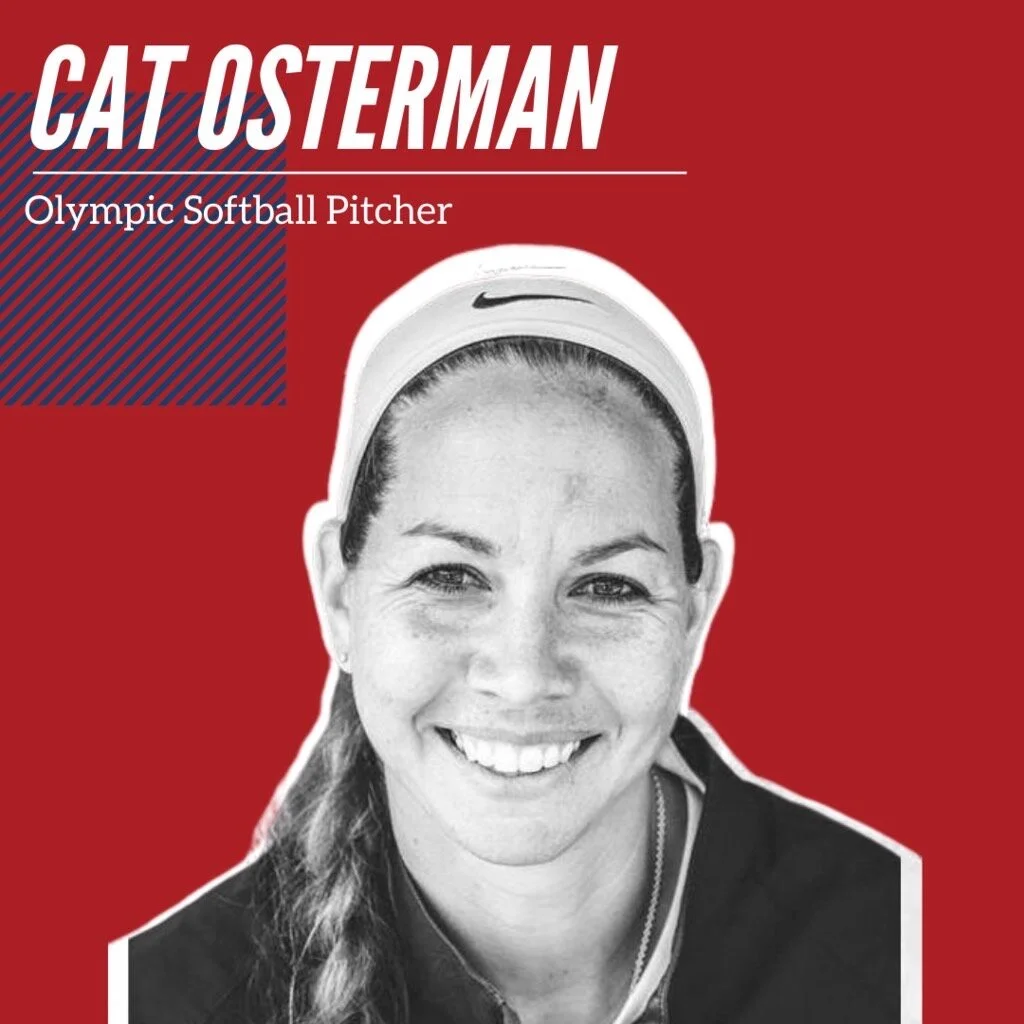
4. Softball is back on the Olympic schedule and so is Cat Osterman
Laura welcomes three-time National Player of the Year, four-time All-American, and two-time Olympic medalist in softball, Cat Osterman, to the podcast today. Cat is an incredibly successful, multiple record-holding pitcher who is now an Assistant Coach at Texas State, and is coming out of retirement to play for Team USA at the Tokyo Olympics next year now that softball has been reinstated.
In this episode, Cat describes her start in softball, her journey to becoming a star at the University of Texas, and her experiences at both the 2004 and 2008 Olympics. She also shares her standout collegiate career moment, the difference between pro and college ball, and softball’s fluctuating status with the Olympics. Her coaching career, her return to softball, and how she and her team are handling these unusual times are also explored, and she offers some sage advice for up and coming athletes when dealing with adversity such as this pandemic. Cat Osterman is an elite athlete possessing a vast amount of knowledge, skill, and insight regarding both sport and life in general, and you will be educated, informed, and inspired as you listen in on this conversation today.
Episode Highlights:
Cat’s start in softball and her journey to the University of Texas
Cat’s road to the Olympics and her advice for others doing the same
Her first Olympic Games adventure in 2004
Cat’s standout moment from her collegiate career
The difference between pro and college ball
Her second Olympics in 2008
Softball’s changing status with the Olympic Games
The coaching/playing relationship
Cat’s situation when the pandemic struck and how she and her team are navigating it
Her advice to young athletes handling adversity
Quotes:
“That 2004 group was a special group, how we kind of gelled and worked together.”
“When we’re immersed in this sport and it’s what you love to do…you almost do anything to make sure it happens.”
“Keep your eye on your goal, and remember to do your part towards that goal.”
“With team…you also love bronze, because you’re winning the bronze, whereas a silver, you’re losing the gold.”
“Everything we preach to our kids, we have to remember it applies to ourselves as well.”
“In just being a teammate and communication-wise, I think coaching has helped me be a better player more than playing has helped me be a better coach again.”
“Control what you can control.”
Links:
The Pursuit of Gold homepage: http://thepursuitofgold.com/
Cat’s homepage: https://www.catosterman.com/
Cat’s instagram: https://www.instagram.com/catosterman/